15 Smart Small Garden Layout Ideas That Make the Most of Every Foot

Small garden layout ideas are most useful when they solve a specific space problem: an awkward corner, a narrow side yard, a paved patio, or a compact vegetable plot that still needs a clear path. The goal is not to pack plants into every empty inch. It is to make every part of the garden easy to reach, water, harvest, and enjoy.
The 15 layouts below can be adapted to balconies, courtyards, small backyards, and raised beds. Each one includes a best-fit situation and an important limitation, so you can choose a plan based on the shape, sunlight, and care demands of your site rather than appearance alone.
In Short
The most efficient small-garden layout keeps all planting areas within comfortable reach, reserves an unobstructed route for care, and places tall crops where their shade will do the least harm. Start by mapping sun, doors, water, drainage, and mature plant size. Then choose one layout pattern—such as narrow borders, modular beds, container clusters, or a rear trellis—and leave enough open space to maintain it safely.
Key Takeaways
- Access is productive space: a reachable plant is easier to water, inspect, and harvest.
- Beds should be narrow enough that you never need to step into the growing soil.
- Vertical supports save ground area only when they are stable and their shade is planned.
- Containers are most manageable when grouped by similar light and water needs.
- The best layout leaves room for mature plants instead of using nursery-pot size as the spacing guide.
Choose a Layout That Fits the Site
Begin with a measured sketch. Mark doors, gates, steps, utilities, drains, railings, existing trees, and the nearest practical water source. Record direct sunlight at several points during the day. A graph-paper garden planner can make the first draft easier, but a simple hand-drawn plan is enough when the measurements are accurate.
Draw containers and beds at their finished outside dimensions. Then add the mature spread of the plants, the reach needed for pruning and harvesting, and the space required to move a watering can or hose. If you are still deciding what the space could contain, these small backyard garden ideas provide additional examples that can help you define the garden’s main purpose.
Protect reach and circulation
A bed that is accessible from both long sides is commonly kept no more than about 4 feet wide. When you can reach it from only one side, a narrower bed—often about 2 feet—is more practical. These are useful starting points, not guarantees; your comfortable reach, mobility needs, and the crops growing at the edge should determine the final width.
Path width also depends on use. A compact footpath can work in a tiny private garden, while a route used with a wheelbarrow, mobility device, or frequent carrying needs more clearance and a stable surface. Never let a container narrow an exit or interfere with a door swing.
Place height deliberately
Trellised cucumbers, pole beans, tomatoes, corn, and tall ornamentals can cast meaningful shade. In much of the Northern Hemisphere, positioning taller plants toward the north side often reduces unwanted shade on shorter sun-loving crops. Site conditions still matter: nearby walls, fences, and trees may change the useful position.
15 Small Garden Layout Ideas for Real Spaces
1. One-Sided Border Layout

Best for: A fence, wall, deck edge, or boundary where you want to preserve the center as open space.
Run one narrow planting bed along the perimeter and keep it reachable from the open side. Arrange low herbs or flowers at the front, medium plants in the middle, and a carefully secured support at the back. This layout makes a small yard feel wider because the main floor area remains visually open. Its limitation is reach: do not make the border so deep that plants against the wall become inaccessible.
2. Two Slim Parallel Beds

Best for: A rectangular vegetable plot with one clear central route.
Place two long, narrow beds on either side of a central path. The path becomes the working spine for watering, harvesting, and moving through the garden. This arrangement is easy to divide into crop families or seasonal sections. Keep the beds narrow enough to reach from the path and outer edges; otherwise, the apparent gain in soil area is lost to difficult maintenance.
3. Compact 4 × 4-Foot Bed

Best for: A beginner who wants one defined growing area rather than many containers.
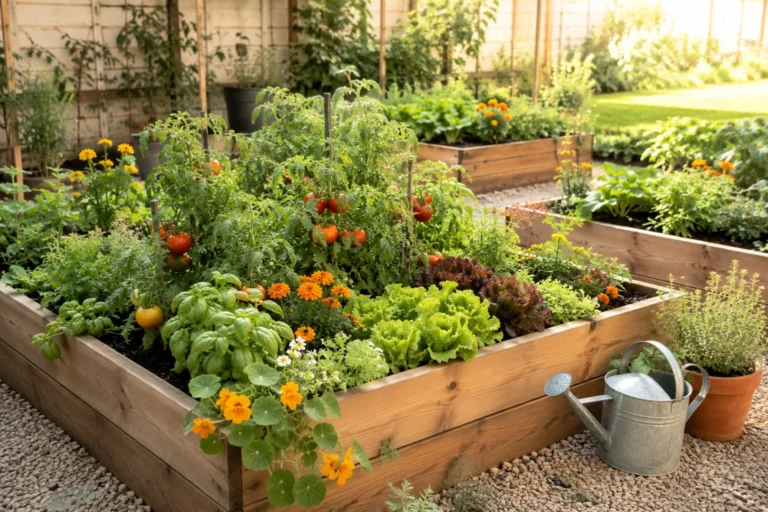
A 4 × 4-foot bed can be reached from all four sides and divided into simple crop zones. Put a small trellis along the side that causes the least harmful shade, reserve the center for upright crops, and use the edges for herbs, lettuce, radishes, or flowers. Do not place it tightly against a fence; the layout depends on access from every side. Review the raised-bed gardening guide before choosing depth, soil, and materials.
4. Four Modular Squares

Best for: An irregular yard, phased budget, or gardener who wants distinct crop sections.
Use four small beds or planters—such as 2 × 2-foot modules—with narrow access around them. The modules can step around a drain, tree root zone, or awkward corner and can be installed over time with a modular raised-bed kit or simple containers. The tradeoff is more edging and slightly more path area than one large bed, but access and crop separation are excellent.
5. L-Shaped Corner Garden

Best for: Using two adjoining boundaries without closing in a courtyard or patio.
Arrange two narrow beds or rows of containers at a right angle. The inside of the L can frame a small chair, birdbath, or focal pot while leaving the diagonal view open. Repeat a limited range of materials to keep the corner calm. Check that both arms remain reachable; the inside corner can become a neglected pocket when the beds are too deep.
6. U-Shaped Courtyard Layout

Best for: A small enclosed space where maximum edge access matters.
Place shallow beds or containers along three sides and keep the middle as a working court. You can reach most plants while standing in one central area, which makes efficient use of a compact footprint. Leave the open end generous enough for entry and carrying supplies. In a hot, walled courtyard, reflected heat may be intense, so match plants and containers to the microclimate.
7. Narrow Side-Yard Ribbon

Best for: A sunny passage that must remain usable from end to end.
Keep one uninterrupted path along the access side and use a slim ribbon bed or a row of rectangular planters against the opposite boundary. Grow upright herbs, chard, bush beans, compact peppers, or flowers rather than sprawling vines. Confirm that gates, utility meters, vents, and air-conditioning equipment remain accessible. This plan fails when gardening slowly consumes the path.
8. Patio Container Cluster

Best for: Paved spaces, rentals, or a flexible first garden.
Group containers in two or three clusters instead of scattering individual pots across the patio. Use larger pots as anchors and smaller compatible containers around them, while keeping drainage and airflow in mind. Grouping simplifies watering and looks intentional. Self-watering containers may reduce moisture swings for suitable crops, but reservoirs still need monitoring and correct overflow drainage.
9. Balcony Railing-and-Floor Layout

Best for: A balcony where floor area is limited but safe railing use is permitted.
Place the heaviest, largest containers on the floor in approved positions and use securely fitted railing planters only where building rules allow. Keep the door, drain, and required exit route open. Herbs and leafy greens often suit this pattern better than large vines. The balcony herb garden guide offers crop and container guidance. Never guess about structural weight or attach planters where they could fall.
10. Rear-Trellis Vertical Layout

Best for: A sunny bed where climbing crops can form the back layer.
Install a sturdy vegetable trellis at the rear of a narrow bed and grow pole beans, peas, or compact cucumbers upward. Plant shorter crops in front, allowing enough space for airflow and harvesting. Vertical growth reduces vine sprawl, but it does not justify closer root spacing than the crop requires. If you need a freestanding support, use the measurements and safety guidance in the simple garden trellis tutorial.
11. Keyhole Bed

Best for: A roughly square area where a central access notch improves reach.
A keyhole layout wraps a bed around a short path or central standing point. It provides more reachable edge than a solid block of the same outer size and can create a strong visual shape. Keep the arms narrow and the entry wide enough to use comfortably. Complex curves may require more edging and careful irrigation than straightforward rectangles.
12. Mini Potager Layout

Best for: Combining food crops with an orderly ornamental appearance.
Divide one compact bed into a clear geometric pattern and repeat herbs, greens, and restrained flowers around a central crop or small support. Choose plants for compatible sun and water needs, not color alone. Regular harvesting and replacement planting keep the pattern legible. A mini potager is attractive, but it requires more editing than a casual mixed bed.
13. Cut-and-Come-Again Salad Garden

Best for: A shallow raised planter or compact bed devoted to frequent leaf harvests.
Organize short bands of lettuce, arugula, spinach, Asian greens, and small herbs according to season and climate. Sow modest amounts at intervals instead of filling the entire bed on one date. This layout can deliver repeated harvests from limited area, but greens may bolt in heat or struggle in unsuitable seasons. Use locally appropriate planting windows.
14. Succession-Planted Vegetable Bed

Best for: A gardener willing to replant open spaces through the growing season.
Divide the bed into dated zones and replace finished crops with the next locally suitable planting. For example, spring radishes or peas might be followed by a warm-season crop, then a fall green where the climate allows. The layout uses time as well as area, but it requires a calendar, seed supply, and realistic days-to-maturity calculations. A compact drip-irrigation kit can simplify watering when zones are planted at different times.
15. Edible-and-Flower Mixed Border

Best for: A front yard or visible patio edge where productivity must look intentional.
Combine compact vegetables and herbs with flowers selected for the site. Repeat a few plants rather than using one of everything: chard, parsley, basil, compact peppers, calendula, dwarf marigolds, or locally suitable pollinator plants can form a coherent scheme. Confirm edibility before harvesting any flower, and avoid pesticide use that conflicts with food crops. For stronger visual structure, use the principles in these small garden design tips.
How to Select the Best Small Garden Layout
| If your main constraint is… | Start with… | Check before committing |
|---|---|---|
| A paved surface | Patio container cluster | Drainage, filled weight, and watering frequency |
| A narrow yard | One-sided border or side-yard ribbon | Required access to gates and utilities |
| One small open plot | 4 × 4-ft bed or two parallel beds | Reach from every working side |
| An awkward shape | Modular squares or L-shaped layout | Path continuity and irrigation |
| Very limited floor area | Rear-trellis or balcony layout | Support stability, shade, wind, and weight |
| Maximum seasonal harvest | Salad or succession layout | Planting calendar and replanting time |
| Appearance from the house | Mini potager or mixed border | Maintenance needed to preserve structure |
Choose the simplest plan that serves your main goal. A layout can mix two compatible patterns—for example, parallel beds with a rear trellis—but stacking too many concepts into one tiny site usually weakens access and makes the garden harder to manage.
What to Plant Without Overcrowding
Use the mature dimensions and spacing on the seed packet or plant label. Terms such as “patio,” “bush,” “dwarf,” “compact,” and “determinate” can identify space-conscious cultivars, but they do not mean every variety has the same final size. Check the actual description.
Prioritize crops you eat and that suit your conditions. Herbs, leafy greens, radishes, bush beans, compact peppers, and selected patio tomatoes can be practical options. Large pumpkins, full-size winter squash, corn, and sprawling melons can overwhelm a tiny plot unless you deliberately allocate the necessary room. For approachable crop choices, compare these easy vegetables for beginner gardeners.
Benefits
- A defined layout makes watering, harvesting, and pest inspection more systematic.
- Narrow beds and clear paths protect soil from unnecessary foot traffic.
- Compact cultivars and supports can increase the useful range of crops.
- Repeating containers and plants can make a productive garden feel visually calm.
Considerations
- Intensively planted beds can demand close attention to water and fertility.
- Vertical structures may cast shade and catch wind.
- Numerous small containers can dry quickly and take longer to water.
- A complex decorative pattern may be difficult to maintain through seasonal changes.
Common Small Garden Layout Mistakes
Planning around young plant size
Nursery plants and seedlings leave generous-looking gaps in spring. Those gaps are intentional. Draw the mature canopy and support, not the pot, so paths and neighboring crops remain usable later.
Using every inch as planting space
Paths, working clearances, hose routes, and open sightlines are not wasted. They are what make the planted areas functional. If you must step over pots or lean across a wide bed, simplify the plan.
Adding a trellis after vines are established
Install the support before planting or while plants are small. Late installation can damage roots and stems. Anchor it for the expected wind and mature crop load rather than relying on the empty display appearance.
Ignoring water distribution
Mixed containers and densely scheduled beds do not always dry at the same rate. Group plants with compatible moisture needs and inspect the growing mix before watering. Do not assume one timer duration suits every pot.
Choosing a layout only from an overhead image
A plan view can hide wall shade, railing height, wind exposure, slopes, and the vertical mass of mature plants. Evaluate the layout from the side and from the main entrance before building it.
Myth
A small garden should be planted as densely as possible
Reality
High density can increase competition, humidity, and maintenance when spacing, airflow, water, fertility, and mature plant size are ignored. Efficient layout means using reachable space deliberately—not eliminating every gap.
Frequently Asked Questions
What is the easiest small garden layout for a beginner?
One 4 × 4-foot bed accessible from all sides or a cluster of three to six larger containers is usually easier to understand and maintain than many tiny beds. Choose between them based on the surface, permanence, budget, water access, and permission to build.
How wide should a small raised bed be?
A bed reachable from both sides is commonly kept to about 4 feet wide or less. When it is accessible from only one side, about 2 feet may be more practical. Adjust the width to your comfortable reach and accessibility needs so you never need to step into the soil.
Where should a trellis go in a small garden?
Place it where climbing plants receive suitable light and cast the least harmful shade on shorter sun-loving crops. In many Northern Hemisphere gardens, the north side is a useful starting point, but buildings, fences, trees, wind, and the actual sun path can change the best position.
How do you lay out a small garden on a patio?
Group containers into a few care zones, keep the doorway and main route open, protect drainage, and put tall or heavy containers where they remain stable. Use the brightest area for sun-loving fruiting crops and choose shade-tolerant plants for less sunny positions.
Can flowers and vegetables share a small garden layout?
Yes, when the plants have compatible light, water, spacing, and soil needs. Use flowers to repeat color or soften edges without crowding food crops. Confirm a flower is edible before harvesting it, and follow pesticide labels carefully around edible plants and pollinators.
How can a small garden produce more without overcrowding?
Select productive compact crops, grow suitable vines vertically, harvest regularly, and replant open areas only when the next crop fits the local season. Good soil, appropriate spacing, consistent water, and pest monitoring matter more than filling every gap.
Build the Layout Around How You Will Use It
The best small garden layout is not necessarily the one with the largest planted percentage. It is the one that keeps every crop reachable, matches the site’s sunlight and water, leaves essential routes open, and still works when plants reach mature size.
Choose one of the 15 patterns as a starting point, draw it to scale, and test the path and reach before buying materials. Begin with fewer plants than the drawing appears able to hold. You can add a container or replant an open section later; recovering a crowded garden is much harder.
Sources and Further Reading
- University of Maryland Extension: Planning a Vegetable Garden — site selection, garden systems, layout, access, and beginner planning principles.
- University of Maryland Extension: Growing Vegetables in Containers and Salad Tables — container selection, crop suitability, growing media, placement, and care.
- University of Minnesota Extension: Raised Bed Gardens — raised-bed benefits, placement, materials, and accessibility considerations.
- University of Minnesota Extension: Trellises and Cages to Support Garden Vegetables — support selection, crop spacing, installation, and training guidance.
- University of Illinois Extension: Make a Plan — garden drawing, crop placement, sun, and shade considerations.
- University of Illinois Extension: Raised Bed Checklist — practical bed-width, pathway, depth, and site-planning guidance.